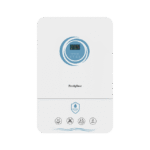
Compare conversion architecture with measured operating requirements, not assumptions about weight or surge power.
High-frequency and low-frequency solar inverter labels describe design approaches, but they do not provide a complete buying specification. Buyers often associate one platform with compact equipment and the other with demanding loads. Those associations are useful starting questions, not reliable acceptance criteria. A sound comparison asks how each actual model performs during normal operation, starting events, low battery conditions and high ambient temperatures. This article explains how to build that comparison without assuming that every inverter within a broad frequency category behaves the same way.
Do not confuse the topology label with AC output frequency
A model described as high-frequency can still deliver the 50 Hz or 60 Hz AC supply required by the load. The category normally refers to an internal conversion approach, rather than a higher frequency at the appliance socket. Likewise, the term low-frequency does not mean that the output should run below the appliance’s specified supply frequency.
Write the required AC output voltage and frequency separately in the purchase specification. Then ask the supplier what the architecture label means for the exact model being quoted. Marketing terminology is not always consistent between manufacturers, and mixed or hybrid designs make a simple two-column classification less precise.
Architecture influences packaging, but packaging is not performance
Transformer arrangement, switching design, power semiconductors, filtering and cooling all contribute to the finished inverter. Size and weight can affect transport, wall loading and service access. They do not establish a universal ordering of efficiency, starting capability or expected life. A heavier unit is not automatically the correct choice, and a lighter one is not automatically unsuitable for a motor load.
Victron’s published inverter documentation describes a hybrid high-frequency implementation with particular startup characteristics. The useful lesson is that a broad architecture name does not settle performance. Compare the actual ratings and test conditions of the candidates; do not transfer a capability from one manufacturer’s design to another product carrying a similar label.
Ask for a time-based surge specification
For a pump, compressor or power tool, the critical event may last longer than the instant represented by a peak-power headline. Request an overload or surge rating with duration, the applicable battery voltage and relevant temperature conditions. Confirm whether the rating is expressed in watts, VA, current or a combination of limits.
Suppose two candidates both advertise a peak figure twice their continuous rating. One has a documented time interval and a stated recovery behavior; the other gives no duration. These are not equivalent procurement offers. The missing information must be resolved before deciding which can support a particular starting event. The same approach applies to both high-frequency and transformer-based platforms.
| Comparison item | Request from each candidate | Why it changes the decision |
|---|---|---|
| Normal output | Continuous W and VA at the stated ambient temperature | The nameplate maximum may not apply to a hot room |
| Starting event | Permitted overload magnitude, duration and recovery conditions | A short peak figure cannot describe every motor start |
| Low-load operation | No-load consumption and part-load performance | Small continuous losses accumulate over long standby periods |
| Charging | AC charger and PV charger specifications separately | Architecture does not tell you what charging hardware is included |
| Installation | Dimensions, mass, clearances and service-access requirements | A technically suitable unit must also fit the intended location |
Compare energy losses over the actual duty cycle
Maximum efficiency is one operating point. A backup system may spend much of its time supplying a small background load, charging a battery or waiting for a utility failure. Ask whether efficiency information includes those conditions and whether a low-power mode changes output availability.
As a simple illustration, an additional 15 W of standing consumption sustained for 24 hours uses 0.36 kWh per day. Over five days that becomes 1.8 kWh. This is an arithmetic example, not a measured difference between Techfine products. It explains why an application with long standby periods may reach a different decision from an application operating near its rated load for short working shifts.
Record the expected hours in standby, light-load and normal-load operation. Compare the whole duty cycle rather than selecting solely from either the highest efficiency percentage or the lowest no-load figure.
Check charging and system interfaces independently
Some products combine inversion, utility charging and solar charging. Others require separate equipment for part of that work. The internal frequency label cannot tell you whether MPPT is built in, whether lithium battery communication is supported or which battery voltages are available. Each item needs its own line in the comparison.
The Techfine VS-series manual is an example of why buyers should use a matching model document: it contains operating modes and settings beyond a simple power rating. For an order, obtain the document applicable to the precise series, hardware version and battery configuration. A familiar family name does not prove that an optional function is included.
Build an application-based shortlist
For a small office, begin with the IT and lighting load, acceptable interruption and expected outage duration. For a workshop, add the starting behavior and duty cycle of the actual machines. For a residence, distinguish essential circuits from large discretionary loads. These different starting points are more useful than deciding the architecture first and trying to make the loads fit afterward.
Bring installation constraints into the shortlist early. Check the mounting surface and the space available for ventilation and maintenance. If the unit will be transported frequently, handling requirements deserve explicit attention. If it will remain in a dusty utility room, ask how its installation and service instructions address that environment. Use the model documentation rather than a general reputation for ruggedness.
Agree a sample evaluation before a bulk purchase
- Freeze the candidate model, firmware, battery arrangement and accessory list.
- Define the normal load and any critical starting sequence using actual equipment.
- Record ambient temperature and battery conditions for the evaluation.
- Agree what constitutes acceptable operation, including alarms and recovery.
- Have qualified personnel perform electrical measurements and commissioning checks.
- Keep the results alongside the exact model and settings used.
A successful demonstration should be repeatable under agreed conditions. Avoid accepting a different sample model or a demonstration with an undisclosed battery arrangement as proof for the order. Test evidence should follow the equipment being supplied.
Frequently asked questions
Are low-frequency inverters always better for motors?
No architecture label proves compatibility with a particular motor. Compare documented surge duration, voltage behavior, battery limits and the starting requirements of the actual equipment.
Are high-frequency inverters always more efficient?
A general label is insufficient. Compare efficiency and standing consumption at the load levels, temperatures and operating modes relevant to the intended duty.
Which Techfine category should I inspect first?
Start with the required system function. Review hybrid solar inverters for the relevant solar and battery platform, or off-grid inverter platforms for independent and backup-power requirements. Then compare the exact models against the same load sheet.
Technical references
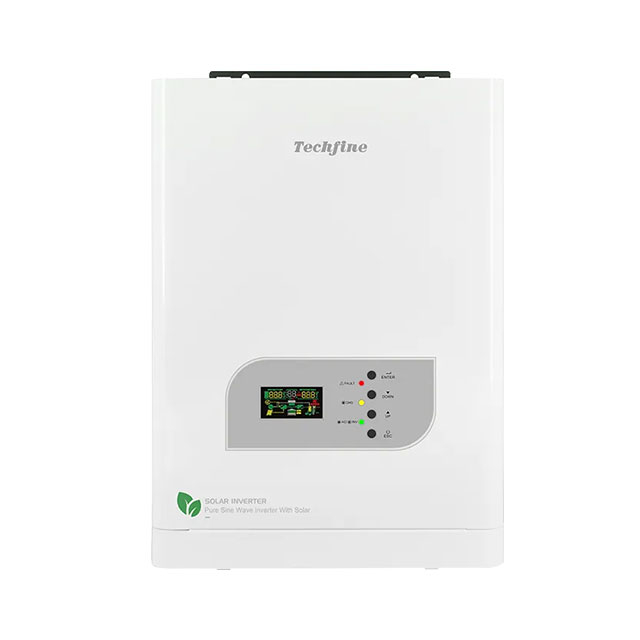
Victron inverter design and rating example; Techfine VS-series manual; Techfine off-grid family overview. External product ratings are not specifications for another model. The photograph illustrates a Techfine inverter platform, not a comparative test.