Choosing between a naturally cooled and a fan-cooled MPPT controller is partly a decision about the installation environment and future maintenance. The cooling label alone does not establish usable charging power, dust resistance or acoustic suitability. Compare the exact controller versions at the temperature and duty expected on site, then check how their heat paths will remain effective after months of operation.
Start with the heat path
A controller converts electrical power with some loss. That loss becomes heat which must leave the equipment. Natural cooling relies on the intended heat-transfer surfaces and surrounding air without an internal cooling fan. Fan cooling uses forced airflow to assist heat removal. Both arrangements depend on the installation conditions permitted by the manufacturer.
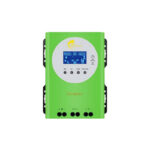
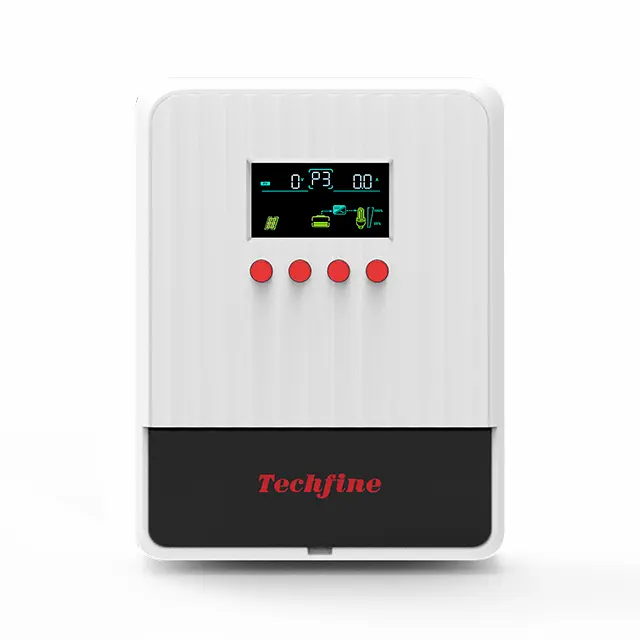
For example, the Techfine PA series specification lists natural cooling, while the MB series specification lists fan cooling. These are model-family distinctions, not a claim that either arrangement is inherently superior. The chosen controller must first satisfy the electrical requirements of the proposed system.
Distinguish operating range from full output
An operating-temperature range describes permitted conditions as defined by the supplier. It should not automatically be interpreted as a promise of full charging current at every temperature within that range. A controller may reduce output as temperature rises, and the relevant threshold can depend on the exact model or installation arrangement.
Request the current-versus-temperature information and any mounting assumptions used for it. If the supplier has not published a derating curve, ask for written clarification for the planned duty. Record the uncertainty in the comparison rather than filling the gap with a curve from an unrelated controller.
Match peak solar production to the room conditions
Controllers often work hardest during periods when the installation space is also warm. A room-temperature reading taken early in the morning may miss the important condition. Evaluate the equipment location during the expected charging window and consider other heat-producing devices in the same space.
A hypothetical cabinet could be comfortable when inspected but much warmer after several hours of solar charging and inverter operation. In that situation, selecting a larger current rating without reviewing the cabinet’s thermal design may leave the original constraint unresolved. The assessment should follow the complete heat path from controller surfaces to surrounding air and out of the enclosure.
Dust and enclosure ratings require separate checks
A controller without a fan is not automatically sealed against dust. Likewise, a fan-cooled controller should not be assumed to tolerate unrestricted workshop contamination. Check the declared enclosure rating, permitted environment and installation instructions independently from the cooling method.
Ask whether the site contains fine dust, fibers, moisture or corrosive contaminants. If an additional cabinet is proposed, confirm that it meets both environmental and thermal requirements. Putting equipment inside an unventilated box can change the cooling conditions on which its rating depends. Do not add filters, covers or external fans as an improvised modification without supplier approval.
Compare noise using defined conditions
Natural cooling removes one possible source of fan noise, but it does not establish that the complete solar installation will be inaudible. Other equipment, relays and operating effects may remain noticeable. For a fan-cooled unit, noise can also vary with temperature, charge demand and fan-control behavior.
If the location is near occupied rooms, define where sound will be assessed and under which operating conditions. A brochure figure without measurement distance, background level or duty condition may be inadequate for comparison. Ask the supplier to explain the relevant acoustic data rather than treating every quoted decibel value as directly comparable.
A cooling-selection worksheet
| Decision area | Natural cooling review | Fan cooling review |
|---|---|---|
| Mounting | Confirm orientation and unobstructed heat-transfer surfaces | Confirm orientation and free inlet/exhaust paths |
| Hot operation | Obtain model-specific output conditions | Obtain model-specific output and fan-control conditions |
| Contamination | Check enclosure protection separately | Check airflow contamination and approved maintenance |
| Service access | Allow inspection and external cleaning | Allow inspection and any authorized fan servicing |
| Noise | Assess the whole installed system | Assess representative fan operating states |
Plan maintenance before selecting the enclosure
The owner should know which inspections are permitted, how often the environment should be reviewed and when a qualified service technician is required. A cooling path that cannot be reached without dismantling adjacent equipment may be neglected. Include access in the layout rather than assuming it can be arranged after installation.
For fan-cooled products, ask whether the fan is a serviceable item, who may replace it and which spare is approved. Do not promise a field-replaceable fan merely because the casing contains one. For naturally cooled products, inspect the manufacturer’s guidance on heat-sink cleanliness and clearance; the absence of a fan does not remove all maintenance considerations.
Use a representative acceptance period
A useful acceptance review records ambient conditions, controller output, charging stage and any thermal warnings during an agreed representative duty. The observation needs enough context to distinguish temperature-related reduction from a battery approaching its charge target. Falling current by itself is not proof of thermal derating.
Compare the result with the supplier’s stated conditions and preserve the record as a baseline. If the installation later behaves differently, the service team can compare contamination, room conditions, load changes and equipment status against a documented starting point. This is more informative than a statement that the controller “felt hot” on one visit.
Include operating cost in the decision
Compare the practical consequences of each installation proposal over its expected service period. The lower equipment price may require more frequent access in a dusty environment, while a quieter location may need a different approved cabinet arrangement. These costs belong to the complete solution, and they cannot be inferred from the controller current rating alone.
For a remote site, ask how a cooling-related alarm will be detected and who can reach the equipment. A local owner may be able to report a warning or inspect an external obstruction, but internal work can require authorized service. Include travel, available spares and acceptable downtime in the purchasing discussion rather than discovering those requirements after an interruption.
Keep the final selection rationale with the project record. State the expected environment, approved mounting arrangement, supplier confirmation and maintenance responsibility. This gives later operators a reason to preserve the clearances and location originally accepted. It also provides a clear review trigger if the room is repurposed, another heat source is added or the controller is moved to a different enclosure.
Questions buyers should settle
Is natural cooling maintenance-free?
It avoids a cooling fan within that design, but mounting clearances, contamination and environmental suitability still require attention. Follow the actual maintenance instructions.
Does a fan guarantee higher output in a hot room?
Only model-specific ratings and conditions can establish usable output. The presence of a fan cannot compensate for an installation outside the approved environment.
Can the cooling method be changed later?
Treat cooling as part of the supplied product design. Obtain an approved solution rather than modifying airflow or casing components independently. Select a suitable model and installation arrangement before purchase.
Specification sources: Techfine PA controller and Techfine MB controller. Confirm the supplied revision and its thermal requirements with the quotation.