Adding batteries in parallel can expand a supported storage system, but it is not simply an exercise in adding amp-hour labels. The modules, management configuration, operating conditions and installation must remain compatible. Review the existing bank before ordering another pack, and obtain approval for the complete proposed arrangement. Physical space and matching nominal voltage are useful starting information, not final permission to connect equipment.
Document the bank that already exists
Record each module’s model, capacity version, relevant hardware or firmware identification and service history. Identify the existing communications and protection arrangement. An expansion proposal based only on a battery family name can miss differences between production versions or previously replaced modules.
Assess the current bank’s condition through the manufacturer’s supported process. A module with an unresolved fault should not simply be hidden inside a larger capacity total. Give the supplier the actual history and any relevant alarms so the compatibility review starts from reliable information.
Ask which combinations the manufacturer permits
Obtain the allowed module combinations and maximum supported quantity for the exact products. Some systems have documented provisions for different capacities or ages, while others impose tighter restrictions. Avoid both extremes: assuming any batteries can be mixed, or inventing a universal prohibition that contradicts the selected manufacturer’s approved arrangements.
Victron’s battery installation guidance distinguishes supported combinations for its covered batteries. Those rules do not authorize a Techfine bank. The appropriate Techfine documentation and written supplier confirmation must define the proposed configuration.
Keep parallel and series requirements distinct
A parallel expansion and a series-voltage change create different electrical conditions. Permission for one does not imply permission for the other. State clearly what arrangement is proposed and how it relates to the battery and inverter operating ranges.
Do not transfer the original lead-acid bank arrangement to a lithium product without approval. Nor should a diagram for a different module be treated as a generic connection guide. Qualified personnel must develop and install the supported design for the actual equipment.
Review preparation and state-of-charge requirements
The manufacturer may require specified preparation or matching conditions before modules join an operating bank. Ask what those conditions are and how they are verified through the approved procedure. A similar display percentage or a casual voltage reading is not universal evidence that arbitrary packs are ready to be connected together.
This article does not provide live paralleling instructions. Do not improvise balancing procedures, bridge protective devices or connect packs experimentally. The supplier and qualified installer should define the preparation and commissioning process.
Confirm management roles and addressing
A managed multi-module system may use a defined communication hierarchy and module identification. Confirm how the added battery is included and how the inverter receives the bank’s permitted limits. More modules do not automatically mean more independent data connections to the inverter.
Record the final configuration and check that the reported bank information agrees with the approved module count. A physical connection can exist while capacity or available current is represented incorrectly. The acceptance plan should address management as well as electrical supply.
Reassess aggregate power instead of assuming perfect multiplication
Adding a permitted module can change the bank’s potential energy and power, but actual available capability depends on the supported configuration and operating conditions. Ask for the aggregate continuous and transient limits and how restrictions on individual modules affect the bank.
Do not assume every module will carry exactly the same current under every condition. The design and installation must support the manufacturer’s intended sharing behavior. Any calculations for distribution and protection should use the approved engineering basis rather than an ideal equal-share assumption alone.
Review the rest of the installation
Existing distribution, protection, isolation and support equipment may have been selected for the original bank. An expanded arrangement needs a review of those components and the installation layout. Additional storage can change fault and service considerations even when the normal load remains unchanged.
Also check charging. More energy may increase recovery time under the existing charging limit, while a revised charger setting must still respect the approved bank and all sources. Expansion should produce a complete updated system specification rather than only a new capacity label.
Plan maintenance and partial availability
Ask what happens when one module is unavailable and how the system reports that state. The supported remaining capability may differ from the full bank. Users should not assume the original load remains acceptable after a module is taken out of service.
Document the approved service procedure and responsibility. Several modules do not automatically create redundancy or permission for hot replacement. The installation’s service behavior must be established for the specific architecture.
Use an expansion approval record
| Area | Before expansion | Required confirmation |
|---|---|---|
| Module identity | Existing model and version inventory | Approved added model and combinations |
| Condition and preparation | Service history and current status | Manufacturer’s preparation criteria |
| Management | Existing protocol and bank configuration | Updated module roles and reported limits |
| Installation | Original distribution and protection design | Approved expanded arrangement |
| Acceptance | Original load and runtime requirements | Revised capability and commissioning evidence |
The record should identify who approved each part and which documents apply. Retain unresolved conditions until they are closed. A supplier statement that a product supports parallel operation should lead to this configuration-specific review.
Ask Techfine about the exact expansion
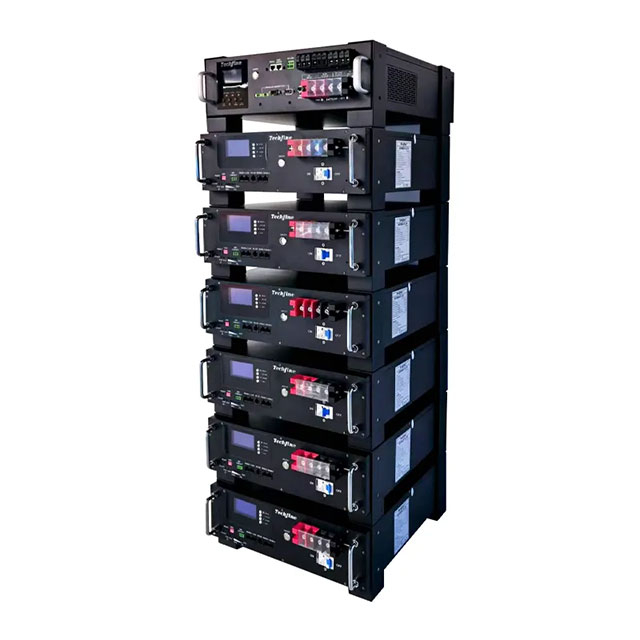
The LC manufacturer page describes expansion features. Such statements should not be generalized to every model or interpreted as approval for an unspecified mixed bank. Use the LC product page to identify the actual platform and request the current arrangement requirements.
Provide the full existing-module inventory, intended additional pack, inverter model, load and charging sources. Ask for the revised maximum capability, management configuration and installation scope. This is more useful than requesting an extra battery solely by matching its nominal voltage.
Keep the updated system record
After qualified installation and acceptance, revise the diagram, module register, settings and maintenance information. Mark the new capacity and the conditions under which it is available. Future service should work from the expanded configuration rather than an obsolete original drawing.
Frequently asked questions
Can new and old batteries always be combined?
No universal rule covers every product. Use the exact manufacturer’s supported combinations and condition requirements.
Does matching nominal voltage establish compatibility?
No. Module design, management, preparation and installation requirements remain relevant.
Will two modules always deliver twice one module’s usable power?
Do not assume so. Obtain the supported aggregate limits and their operating conditions.