A practical load-compatibility guide for choosing inverter output quality before comparing watt ratings.
A pure sine wave inverter and a modified sine wave inverter can carry the same advertised watt rating while supplying very different voltage waveforms. That difference matters when the load contains motors, control electronics or a power supply with particular input requirements. The useful buying question is therefore more specific than “Which inverter is better?” Identify the equipment that must run, check what its manufacturer permits, and compare the inverter under the conditions in which that equipment actually operates. This guide concentrates on waveform compatibility; battery capacity and grid-interconnection approval are separate decisions.
Separate waveform quality from the other ratings
The output waveform describes how AC voltage changes during each cycle. A sinusoidal output follows a smooth alternating pattern, while a modified waveform uses a stepped approximation. Neither description tells you the complete continuous power rating, usable battery energy, transfer time or permitted installation environment. A pure sine wave model can still be too small for a particular load, and a large modified-wave model does not acquire sensitive-load compatibility simply by having more watts.
Request the rated AC voltage and frequency as well as the waveform description. Where a supplier specifies total harmonic distortion, ask for the measurement conditions and whether the figure applies only to a resistive load. A headline measured at one operating point is not a complete description of performance across battery voltage, temperature and load changes.
Start with the equipment, rather than a generic appliance list
Prepare a load sheet with the exact make and model of each appliance. Distinguish its normal running demand from startup behavior and its tolerance for a brief interruption. “Computer,” “pump” and “charger” are broad categories: two products in the same category may use different input circuits. An appliance manual that specifies a sinusoidal supply is stronger evidence than an informal statement that similar equipment worked elsewhere.
| Load characteristic | Question to resolve | Useful evidence |
|---|---|---|
| Motor or compressor | Can it start and operate normally on the proposed supply? | Starting demand, permissible voltage dip and equipment instructions |
| Electronic power supply | Does its manufacturer permit the inverter waveform? | Input specification and written compatibility guidance |
| Speed control or dimmer | Does the control depend on the shape or timing of the AC waveform? | Controller documentation and an agreed functional test |
| Measurement or audio equipment | Are noise and supply-quality requirements stated? | Equipment limits and application-specific acceptance criteria |
| Predominantly resistive load | Are voltage, continuous power and operating duration matched? | Nameplate data, duty cycle and inverter temperature rating |
Understand the compatibility concern without overstating it
Samlex’s manufacturer guidance distinguishes pure sine wave and modified sine wave outputs and identifies applications for which waveform quality matters. That supports treating output quality as a real selection criterion. It does not justify declaring that every electronic device will fail on a modified waveform or that every pure sine wave inverter is suitable for every sensitive appliance. Compatibility remains a relationship between the particular supply and the particular equipment.
For a mixed load whose detailed input requirements are uncertain, specifying a sinusoidal output narrows one important uncertainty. Continue checking regulation, overload behavior and transfer characteristics. Equipment used for a safety-critical function requires its own approved power arrangement; a general-purpose inverter description is not evidence of suitability for that duty.
A worked load example: waveform does not replace sizing
Consider a proposed backup group containing a 70 W router and network system, 180 W of lighting and a refrigerator drawing 150 W while running. The running total is 400 W. Suppose the refrigerator manufacturer provides a starting requirement of 900 VA for the relevant condition. The inverter must then accommodate the starting event alongside the other running loads, subject to its own VA, current and time limits. The 400 W total alone cannot establish that it will start the refrigerator.
Those numbers are an illustrative load exercise, not ratings for a Techfine model. Do not convert the refrigerator’s VA figure into an identical watt requirement without knowing its power factor. Record both the continuous demand and the specified starting event, then request evidence that the selected inverter can support the complete combination. Waveform compatibility and starting capacity must both pass.
Look beyond a single no-load voltage reading
An inverter can show an apparently correct voltage with nothing connected and behave differently when a motor starts or a nonlinear load is added. Agree a representative acceptance test with the supplier or qualified commissioning provider. The test should identify the load models, their operating sequence, battery state, ambient temperature and the measurements used to decide whether operation is acceptable.
Useful observations include whether an appliance starts consistently, whether controls behave normally and whether the inverter reports an alarm. Ask the responsible technician to investigate abnormal noise, unexpected heating or repeated trips rather than repeatedly resetting the system. Live electrical measurements and any waveform inspection belong with suitably qualified personnel and appropriate instruments.
Include the battery supply in the comparison
The inverter cannot deliver its claimed AC behavior independently of the DC source. Battery current limits, voltage sag and the permitted state-of-charge range can constrain operation. For example, 1,000 W of AC output at an assumed 90% conversion efficiency requires about 1,111 W at the DC input. At an illustrative 24 V that is approximately 46 A, before allowing for voltage variation. This calculation is a planning estimate; it is not a cable, fuse or battery specification.
Ask for the battery conditions used during a demonstration. A short successful test with a fully charged battery does not establish performance near the system’s normal discharge limit. Include the approved battery arrangement and the inverter’s low-voltage behavior in the acceptance record.
What to put in a distributor or installer enquiry
- Exact AC voltage, frequency and output waveform requirement.
- Continuous watts and VA where available, plus starting demands and their duration.
- Models of appliances with explicit supply restrictions.
- Battery platform, permitted discharge current and intended backup duration.
- Temperature, ventilation and installation-location requirements.
- Acceptance tests, documentation language and support arrangements.
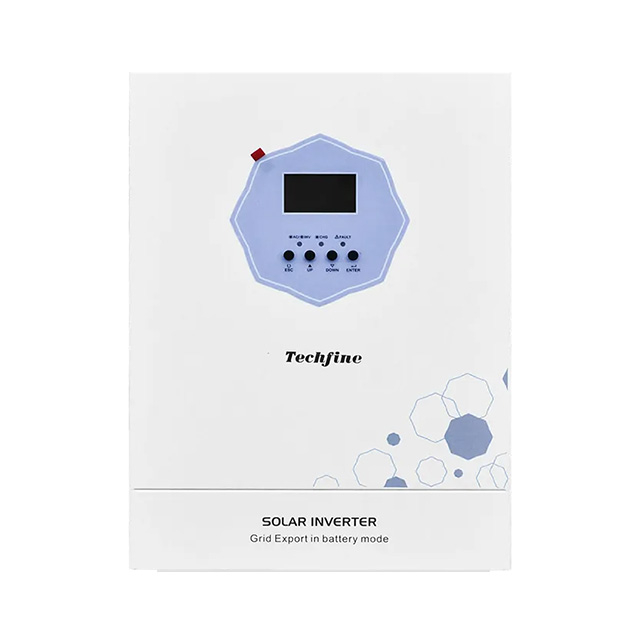
Use the hybrid inverter category or off-grid inverter category to identify a relevant platform, then request the matching model documentation. The photograph illustrates a Techfine inverter; it is not a measured waveform or a compatibility test result.
Frequently asked questions
Does pure sine wave mean an inverter is also a UPS?
No. Output waveform and transfer behavior describe different properties. If equipment must ride through an interruption, check the permitted transfer time, the actual operating mode and the equipment’s own tolerance.
Can extra watt capacity compensate for the wrong waveform?
Additional capacity can address a power limitation, but it does not change the output waveform. Resolve an appliance’s supply restriction directly rather than assuming an oversized unit will overcome it.
Is the “pure sine wave” label enough for procurement?
Use it as one requirement in a written specification. Pair it with voltage and frequency, regulation and distortion information where available, continuous and surge ratings, environmental limits and an agreed load test.
Technical references
Manufacturer background: Samlex inverter waveform comparison. Application-rating context: Victron inverter/charger selection guidance. These references explain general selection principles; their product ratings are not Techfine specifications.