Specify the electrical supply that each load actually needs, including the difference between normal mains operation and battery backup.
Choosing a 110V or 220V inverter begins with the equipment and installation, not with a country name or a familiar plug. Product listings may use rounded voltage labels, while appliance plates and inverter manuals specify a particular nominal voltage, permissible range, frequency and phase arrangement. A buyer who checks only the headline number can overlook a mismatch that appears when the system transfers to battery operation. This guide explains how to assemble a clear AC-interface specification without treating voltage as a measure of inverter power or relying on an adapter to resolve an electrical difference.
Replace a rounded label with the exact supply requirement
A quotation described as “110V” might need clarification about the actual supported nominal output and tolerance. Likewise, a “220V” family description does not tell a buyer whether the selected version is specified for 220, 230 or 240 VAC. Use the exact model documentation rather than assuming that nearby numbers are interchangeable for every appliance.
For each important load, record the voltage range printed on its rating plate or stated in its manual. A device explicitly rated for a broad input range should still be checked for its frequency and connection requirements. A device marked for a single supply condition needs confirmation before it is considered compatible with a different nominal source. The acceptance criterion is the equipment’s permitted input, not the visual similarity of two sockets.
Keep voltage and frequency on separate lines
Voltage and frequency describe different properties of the AC supply. An inverter version that provides the required voltage does not necessarily provide the required frequency, and a configurable feature must be verified for the actual model. Some equipment accepts more than one frequency; other equipment has restrictions or performance differences that must be considered.
Victron’s published 120V inverter manual is an example of a model document that states output settings explicitly. Its defaults and adjustment capabilities belong to that product. For a Techfine purchase, request the equivalent information for the chosen Techfine model and do not copy another manufacturer’s configuration assumptions into the order.
| Specification line | Record this detail | Ambiguity it removes |
|---|---|---|
| Nominal AC voltage | The selected version’s stated output and tolerance | Rounded 110V or 220V marketing descriptions |
| Output frequency | 50 Hz, 60 Hz, or the documented supported settings | The assumption that voltage determines frequency |
| Supply arrangement | Single-phase, split-phase or three-phase as applicable | The assumption that an equal voltage number implies an equal connection |
| Operating mode | Output available during bypass and during inversion | Features that are present only while mains is available |
| Load demand | Watts, VA where applicable, and starting requirements | The assumption that a higher voltage automatically means more usable power |
Check what changes when the utility fails
Equipment can behave differently while passing through an external AC source and while producing its own output from the battery. A supply arrangement seen during normal mains operation must not be assumed to remain available in backup mode. The model’s operating description should identify the terminals and voltages available in each state.
For example, the Victron Quattro-II 2x120V documentation describes a particular distinction between its supported AC-source arrangements and its output in inverter mode. The practical procurement lesson is to compare modes explicitly, not to attribute that behavior to all inverters with a similar voltage label. Ask the supplier to explain the selected model’s operation with the utility present, absent and restored.
Voltage does not replace a power and current calculation
For an illustrative resistive 1,200 W load at unity power factor, the basic relationship P = V × I gives 10 A at 120 V and about 5.2 A at 230 V. The required load power has not changed. The example only shows how AC current relates to voltage under those assumptions; it is not a conductor, protective-device or inverter specification.
Real loads may also require VA, power-factor and starting-current information. A motor or electronic power supply cannot always be represented by a simple resistive calculation. The selected inverter must satisfy the load’s continuous and transient requirements at the intended voltage, while the battery system must support the required DC demand. Increasing the AC voltage does not create extra energy in the battery.
Distinguish output voltage from battery voltage
A 24V or 48V battery platform is a DC-side specification. It is separate from a 120V or 230V AC output. Product titles sometimes combine several voltage values, which makes it especially important to identify what each number describes. Put battery input, PV input, utility input and AC output in separate columns of the comparison sheet.
When several versions share a family name, request the complete model code and a matching photograph of the rating label for the sample or final equipment. A family-level brochure may show options that are not present together on one unit. Confirm the ordered combination before discussing packaging, shipment or accessories.
A plug adapter is not a specification change
A mechanical adapter does not establish that an appliance can accept the electrical supply behind it. Where voltage conversion or a different supply arrangement is required, a qualified designer must select an approved system solution and verify the equipment, protection and installation requirements. Do not use improvised connections to make incompatible equipment appear to fit.
The purchasing team can help by separating connector format from the electrical requirements in the RFQ. Record both, and ask how the supplied product and accessories address them. A response that discusses only socket appearance has not answered the voltage, frequency or phase question.
Prepare a sample acceptance checklist
- Match the sample’s full model code and rating label to the quotation.
- Compare each essential appliance’s input requirements with the inverter output specification.
- Confirm the documented settings and how configuration is recorded.
- Review utility-present and battery-only operating states separately.
- Have qualified personnel verify the intended supply and representative loads under an agreed test plan.
- Keep measured results, configuration and load models with the handover documents.
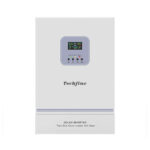
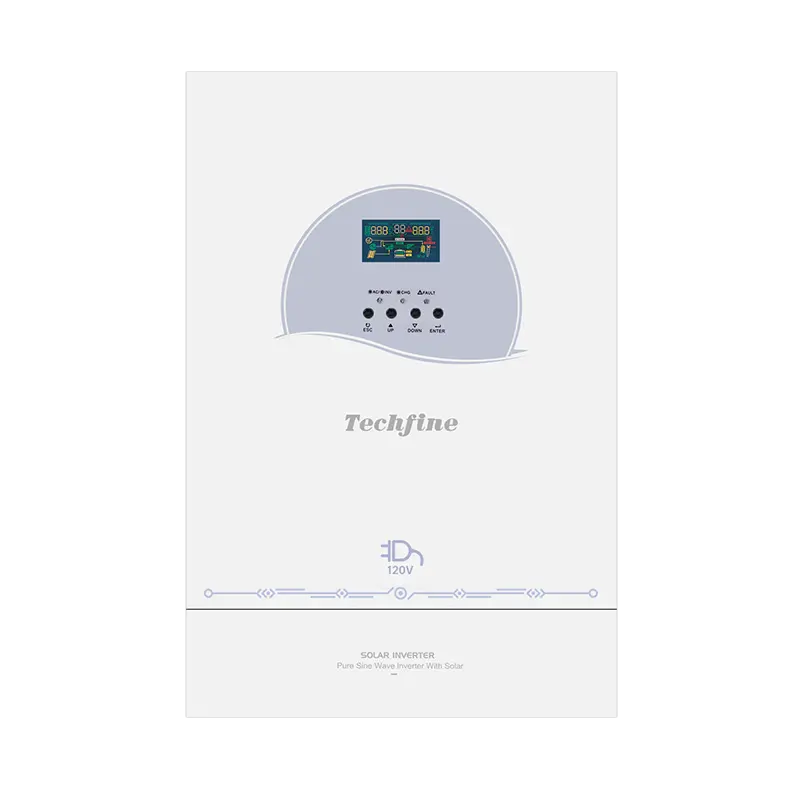
Browse the Techfine hybrid inverter category to identify candidates, then request the correct voltage and frequency version. For output quality, use the separate waveform compatibility guide; matching AC voltage alone does not settle that issue.
Frequently asked questions
Can I select an inverter solely from the destination country?
A destination helps frame the enquiry, but verify the actual premises supply, the loads and the required operating modes. Different installations within a market may have different electrical arrangements.
Does a dual-voltage appliance remove every compatibility check?
No. Confirm the marked range and frequency, connection, power demand and any manufacturer restrictions. A broad input range resolves only part of the comparison.
Should the order say 110V or 120V?
Use the exact nominal output and tolerance documented for the selected model, and include the load requirement. Ask the supplier to resolve shorthand descriptions before accepting the order specification.
Technical references
Victron 120V inverter manual; Victron example of mode-dependent AC behavior. External examples illustrate documentation questions, not Techfine ratings or wiring instructions.