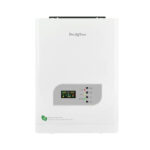
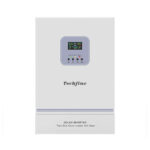
Define how a system uses the utility supply, forms a backup supply and reconnects before choosing a product family.
Hybrid and off-grid inverter descriptions are useful for finding a product family, but they are not a complete system diagram. Buyers need to know which terminals can receive utility power, which outputs remain available during an outage and whether the proposed equipment may export energy. Two quotations can use the same label while describing different operating arrangements. The clearest comparison starts with the required power paths and operating states, then checks the exact model documentation against them. This guide focuses on those system boundaries rather than repeating a general catalogue of inverter types.
Three functions that should be specified separately
First, an inverter may accept an AC input for charging, bypass or another documented function. Second, equipment may be capable of operating in parallel with a public grid. Third, it may be able to establish an independent AC supply for designated loads when the public grid is unavailable. These capabilities are related in some products, but they are not interchangeable.
An AC-input connection does not by itself establish permission or capability to export. A grid-interactive function does not prove that a usable backup output is included. Similarly, a system that can supply independent loads still needs the correct battery, controls and installation arrangement for the intended duty. Ask for each capability explicitly.
Compare operating states, not just terminal names
| Operating state | Question for the proposed system | Evidence to request |
|---|---|---|
| Grid available, solar available | Which source supplies loads and charges the battery? | Mode description and permitted settings |
| Grid available, battery low | Can utility charging or bypass operate, and under what limits? | AC-input and charger specifications |
| Grid unavailable | Which physical circuits can receive inverter power? | Backup-output specification and approved system diagram |
| Battery unavailable | Is any operation supported without it? | Explicit model instructions, including startup conditions |
| Grid restored | What recovery or reconnection behavior is documented? | Commissioning procedure and settings record |
This state table is also useful when comparing quotations. A supplier should be able to connect each promised function to a particular model and accessory arrangement. An unqualified statement that an inverter supports “all modes” leaves too much ambiguity for installation planning.
Keep the backup output boundary visible
During an outage, available backup power is constrained by both the equipment and the energy sources that remain available. The U.S. Department of Energy describes independent operation as a designed capability of an appropriate solar-plus-storage system. It is not something that follows automatically from the presence of solar panels.
Write down the circuits that must remain powered. A home may need lighting, communications and refrigeration without needing an electric water heater at the same time. A shop may need its point-of-sale equipment while a large machine remains off. This is a service requirement for the system designer, not an instruction to move circuits or connect an inverter to an existing building supply without an approved installation design.
Use a load scenario to expose missing information
Imagine a small business with 300 W of network and payment equipment, 400 W of lighting and a refrigerator drawing 200 W during normal operation. The example running demand is 900 W, but the refrigerator’s starting requirement still needs separate investigation. If the business also has a 3 kW discretionary appliance, putting everything on the same backup supply changes the selection substantially.
The correct comparison is not simply “a 5 kW hybrid against a 5 kW off-grid inverter.” Ask whether the quoted system powers the same designated loads, for the same duration, from the same usable battery energy. Include charging and recovery requirements. Otherwise, matching the number on the front page can conceal differences in the actual service provided.
Do not combine export limiting with interconnection approval
Export control, grid protection and permission to connect are separate matters. A feature intended to limit power flow does not establish that the complete installation meets the applicable connection requirements. Obtain model-specific documentation and have the responsible local designer or installer determine the required protection, switching and approval arrangements.
For procurement, record the destination market and the intended operating arrangement before accepting a certificate or a feature statement. Check that any document offered covers the actual model and configuration. Avoid treating a similar family name or an optional accessory as evidence that the quoted equipment includes the required function.
Match the battery and the charging plan
A backup proposal needs usable energy as well as sufficient instantaneous power. For example, a 900 W load running for two hours uses 1.8 kWh at the AC load. The battery must supply more energy after accounting for conversion losses and operating reserve. Those are illustrative quantities; the selected battery’s usable energy and permitted current must come from its documentation.
Also ask how the battery recovers after an outage. A system may have an AC charger, solar charging, or both, with model-specific limits and priorities. If the next outage can occur before the battery has recharged, recovery time becomes part of the backup requirement. Merely adding a larger nominal battery capacity does not answer the charging question.
A comparison sheet for a meaningful quotation
- Exact inverter model, hardware version and supplied accessories.
- Utility-input role, permitted operating modes and export requirement.
- Backup-output voltage, phase arrangement, power and starting capability.
- Designated backup loads and acceptable interruption.
- Battery chemistry, voltage, usable energy and current limits.
- Charging sources, combined limits and recovery priorities.
- Installation environment, documentation and handover requirements.
Start with the Techfine hybrid inverter family or off-grid inverter family, then compare the exact candidates on this common basis. Keep waveform and internal architecture questions separate; the guides on output waveform and conversion architecture address those decisions.
Frequently asked questions
Can an off-grid inverter have a utility input?
Yes, the category name alone does not rule out a documented AC-input function such as charging or bypass. Check what that input actually does rather than assuming it permits grid-parallel export.
Does a hybrid inverter automatically back up the whole building?
No. The available output, switching arrangement, energy sources and selected circuits determine the backup service. The system must be designed for that requirement.
Which label should a purchasing specification use?
A family label can help identify candidates, but specify the required operating states and outputs as well. A written mode-and-load comparison is more useful than insisting on a label without defining its meaning.
Technical references
U.S. DOE: inverters and grid services; Techfine hybrid family overview; Techfine off-grid family overview. Family information is an introduction to selection, not a substitute for the matching model manual.