Translate a business load list into phase-specific requirements before comparing total inverter kilowatts.
A small business may have a three-phase utility service while most of its essential equipment uses single-phase circuits. Another business with a similar total running demand may depend on a three-phase machine. Those situations call for different inverter comparisons. Selecting from total kilowatts alone can miss the connection required by a critical load or the loading allowed on each phase. The useful starting point is a phase-aware inventory of what the business needs to operate, what may remain off during an outage and how the proposed system supplies those loads.
Separate the building supply from the equipment requirement
The presence of three-phase mains does not mean that every connected appliance is three-phase. Lighting, office electronics and other circuits may use individual phases, while some machinery requires a three-phase supply. Review the actual distribution and the equipment documentation with the responsible electrical professional. A business name or industry category is not enough to determine its required inverter output.
Schneider Electric’s explanation of single-phase and three-phase UPS systems highlights the distinction between single-phase loads and a three-phase distribution arrangement. The same distinction is useful when preparing a solar-backup enquiry: identify the supply needed by the load before selecting equipment. A UPS document does not establish the capabilities of a solar inverter, but it helps frame the questions correctly.
Record voltage measurement points as well as the number
A voltage statement should identify the intended supply arrangement. For a three-phase system, distinguish the relevant line-to-line and line-to-neutral requirements where applicable. Two documents can display the same voltage number while describing different interfaces. Neutral availability, earthing arrangements and protection belong to the installation design and must not be inferred from a catalogue headline.
Put the exact output voltage, frequency and phase arrangement into the RFQ. If an existing load has a motor drive or another conversion stage, obtain the documentation for the complete equipment rather than guessing its supply requirement from a component inside it. Any proposed compatibility solution needs confirmation from the equipment supplier and the system designer.
Build a phase-aware load schedule
| Load group | Information to record | Decision it supports |
|---|---|---|
| Office and communications | Supply arrangement, running W/VA and interruption tolerance | Whether selected essential circuits meet the business need |
| Single-phase refrigeration or pumps | Assigned circuit, starting requirement and duty cycle | Loading and startup demand on the relevant phase |
| Three-phase machinery | Required supply, normal demand and starting/control method | Whether true three-phase output is necessary |
| Discretionary loads | Whether they may remain disconnected during backup | How to avoid oversizing for equipment not needed in an outage |
| Future expansion | Defined additional equipment rather than a vague allowance | Whether the proposed platform can support the planned change |
Record where loads are connected in the actual design rather than simply dividing the total by three. This load schedule is a review document for the installer; it is not a guide for moving circuits or changing a distribution board without professional assessment.
Total output capacity may not describe the largest single-phase load
For an illustrative balanced 9 kW load, an equal allocation would be 3 kW per phase. A different schedule containing 6 kW on one phase and 1.5 kW on each of the other two still totals 9 kW. That second arrangement raises a different question about permissible unbalanced loading. The arithmetic does not prove that a particular 9 kW inverter supports either arrangement.
Ask the manufacturer for the selected model’s per-phase limits and any documented unbalance capability. Check the continuous condition and the relevant starting events. Do not assume that spare capacity on one phase can always be transferred to another, or that a total power rating can be used as the rating for a single phase.
Review motor starting in the correct operating condition
A machine that starts successfully while the utility is present may present a different challenge to an independent backup supply. Record the starting arrangement, the other loads already operating and the inverter’s documented transient behavior. The battery system’s permitted power and current also need to support the event.
For procurement, request an agreed representative-load evaluation rather than an unsupported promise that a product is suitable for “all industrial motors.” Distinguish a test of the selected equipment from a demonstration of a different inverter or a different battery arrangement. Keep the conditions and results attached to the model under consideration.
Single-phase modules do not automatically form a three-phase system
Some inverter platforms support coordinated multi-unit configurations; others do not. Connecting several independent units is not evidence of synchronization, phase coordination or approved parallel operation. If a modular proposal is offered, require the manufacturer’s explicit support for that exact arrangement, including compatible units, firmware, controls and system limits.
Also identify how the proposed configuration behaves when a unit is unavailable. The relevant question is which loads remain supported and under what conditions, not merely how many boxes appear in the system drawing. Avoid treating a modular installation as redundant unless that operating capability is actually documented and included in the design.
Compare the business service delivered during an outage
A retailer that needs communications, payment equipment and lighting may accept a limited essential-load arrangement even when the premises has three-phase mains. A workshop that must keep a particular three-phase process running has a different requirement. Define the minimum operating service before comparing the cost and complexity of possible solutions.
Include backup duration, acceptable interruption and recovery after mains returns. These requirements affect battery energy, charging and system controls as well as inverter phase selection. The objective is a documented operating plan for the business, not the largest headline inverter rating that fits the budget.
Questions to close before placing an order
- What exact loads require single-phase or three-phase output?
- What are the nominal voltages, frequency and connection requirements?
- What are the continuous and starting demands on each phase?
- What unbalance or modular-system capability is documented for the selected model?
- Which circuits remain supplied during an outage, and for how long?
- What model-specific drawings, settings and commissioning records will be delivered?
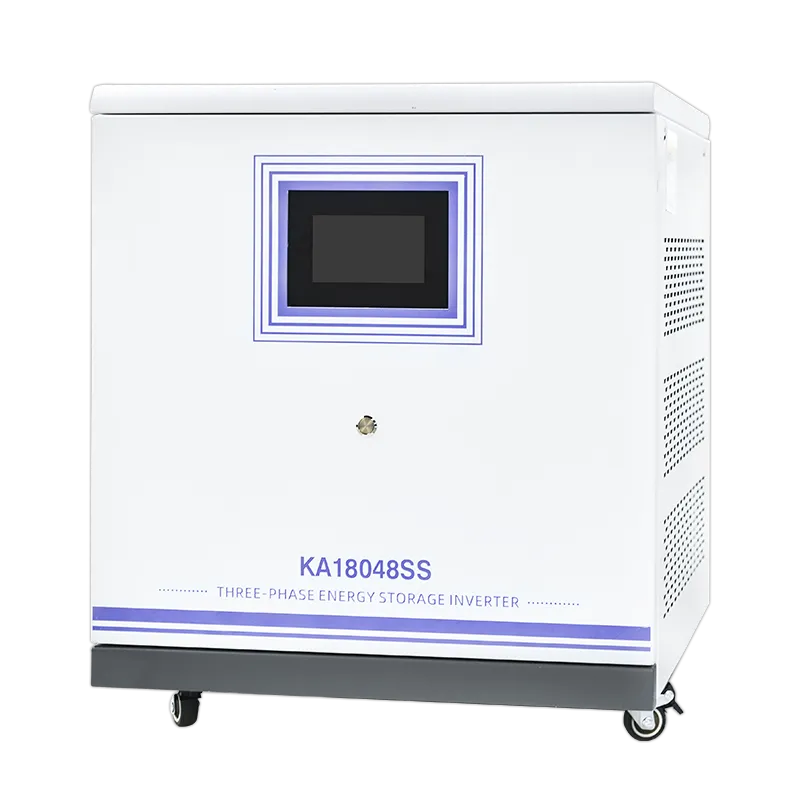
Use the Techfine hybrid inverter category to find candidate platforms, then request a model-level comparison. The architecture comparison guide addresses a different question; an internal topology label does not identify the required output phase arrangement.
Frequently asked questions
Does a three-phase supply make three-phase backup mandatory?
Not solely because it is present. The essential loads and the approved system design determine the required backup output. Equipment that genuinely requires three-phase power must be addressed explicitly.
Can I divide the total inverter rating by three?
That may describe an illustrative balanced allocation, but use the manufacturer’s actual per-phase and unbalance specifications when selecting equipment.
Can three unrelated single-phase inverters replace a supported three-phase platform?
Do not assume so. Use only a manufacturer-supported coordinated arrangement, with the required controls and an approved installation design.
Technical references
Schneider Electric: single-phase and three-phase supply distinction; Techfine model-document download centre. The reference to UPS distribution is general context, not a specification or certification for a Techfine solar inverter.