A UPS’s VA rating does not tell you how many minutes it will support your equipment. Runtime depends on the battery arrangement, actual load and operating conditions. Start by defining how long the service must continue, then request runtime evidence for the exact UPS configuration. A simple watt-hour calculation can explain the energy budget, but it is not a substitute for the manufacturer’s discharge information.
Define what the required minutes are for
A short interruption bridge, an orderly shutdown and continued operation for an hour are different objectives. Identify the action that must finish before backup power ends. A storage system may need time to stop applications and shut down cleanly, while a network installation may need to remain available throughout a longer local outage.
Include the full sequence rather than only the final action. Detection delays, notification, application shutdown and operating-system shutdown all consume time. If a person must respond, consider how that response will happen outside normal hours. The required duration should describe a realistic process, not an optimistic reaction time.
Use the actual load in watts
Measure or estimate the equipment supplied by the battery-backed output during the intended duty. Include network devices, external drives and other dependencies. A UPS that is lightly loaded at idle can experience a different runtime when the protected system is busy or completing an emergency shutdown.
Keep the load assumptions with the runtime request. A statement such as “twenty minutes” is incomplete unless it identifies the power being supplied and the battery configuration. Two suppliers can quote different numbers while referring to different loads, creating a misleading comparison.
Understand what watt-hours can explain
Energy divided by power gives an idealized duration. For an illustrative 200 Wh energy quantity and a constant 100 W load, division gives two hours before losses and operating restrictions. This is an arithmetic demonstration, not the runtime of a real 200 Wh UPS battery. Actual available AC energy can differ from the battery’s nominal figure.
Conversion consumption, discharge characteristics, cutoff conditions, temperature and battery condition all influence the result. At small loads, the UPS’s own consumption can be a meaningful part of demand. At larger loads, battery behavior can make a simple proportional estimate inaccurate. Do not turn an ideal calculation into a guaranteed number of minutes.
Read a model-specific runtime curve
A useful chart identifies the UPS model, load and supported battery arrangement. Compare the point corresponding to the intended duty, and read the assumptions or limitations attached to it. If external modules are involved, use the curve for the approved module count rather than multiplying the internal-battery runtime by an arbitrary factor.
Vertiv’s runtime tools illustrate a manufacturer approach that distinguishes load levels and extended battery configurations. Those values apply to the named Vertiv products. For a Techfine installation, request equivalent information for the exact Techfine model and battery arrangement.
Keep power capacity and energy duration separate
The UPS must first support the load within both its watt and VA limits. More battery energy does not increase those output ratings. Conversely, choosing a higher-capacity inverter section does not establish that enough battery energy is included for the desired duration.
This distinction matters when comparing quotations. One option may offer more output power with a short standard battery duration, while another uses a smaller power platform and an approved extended battery configuration. Compare both against the actual service requirement rather than ranking them only by the largest VA label.
Allow for the condition of the battery
A new-battery runtime estimate should not be treated as a promise that the same duration will remain available throughout the battery’s service life. Follow the manufacturer’s inspection, maintenance and replacement guidance. Environmental conditions and use influence battery condition, so a calendar entry alone cannot verify current capacity.
Ask the supplier what maintenance basis is assumed for the runtime requirement. If a minimum service duration is important, define how its continued availability will be assessed. Do not wait for an actual outage to discover that the original shutdown allowance is no longer available.
Plan recovery between outages
After an outage, the battery needs time to recharge. A system that meets the first event’s runtime may have less available energy during a second interruption soon afterward. Include the expected outage pattern and recovery requirements in the selection discussion.
Check the charger capability and the documented recharge assumptions for the actual battery arrangement. Adding approved battery capacity may extend runtime while also affecting recovery time. A quotation should not present only the most favorable initial runtime and omit the conditions needed to restore it.
Build a runtime evidence worksheet
| Item | What to record | Why it matters |
|---|---|---|
| Service objective | Shutdown, bridging or continued operation | Defines the required duration |
| Load | Watts and relevant operating condition | Locates the correct chart point |
| Battery arrangement | Exact approved configuration and condition basis | Defines the energy source |
| Runtime evidence | Manufacturer chart or reviewed assessment | Supports a traceable estimate |
| Recovery and upkeep | Recharge assumptions and maintenance responsibility | Addresses later outages |
Keep uncertainties visible. If a supplier can only provide an estimate, identify its basis and agree what verification is needed. A detailed assumption is more useful than an apparently precise runtime with no supporting configuration.
Verify without treating deep discharge as routine testing
Use the manufacturer’s approved acceptance and maintenance procedures. A self-test indication and a full runtime assessment answer different questions. Qualified personnel should decide how to verify a critical duration without unnecessarily interrupting service or repeatedly exhausting the battery.
Record the protected load, battery condition and result. If the equipment list changes, revisit the runtime requirement and evidence. A new switch or storage unit can consume the reserve previously allocated to shutdown even when the UPS remains within its power rating.
Ask Techfine for configuration-specific evidence
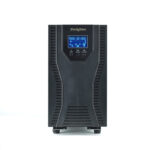
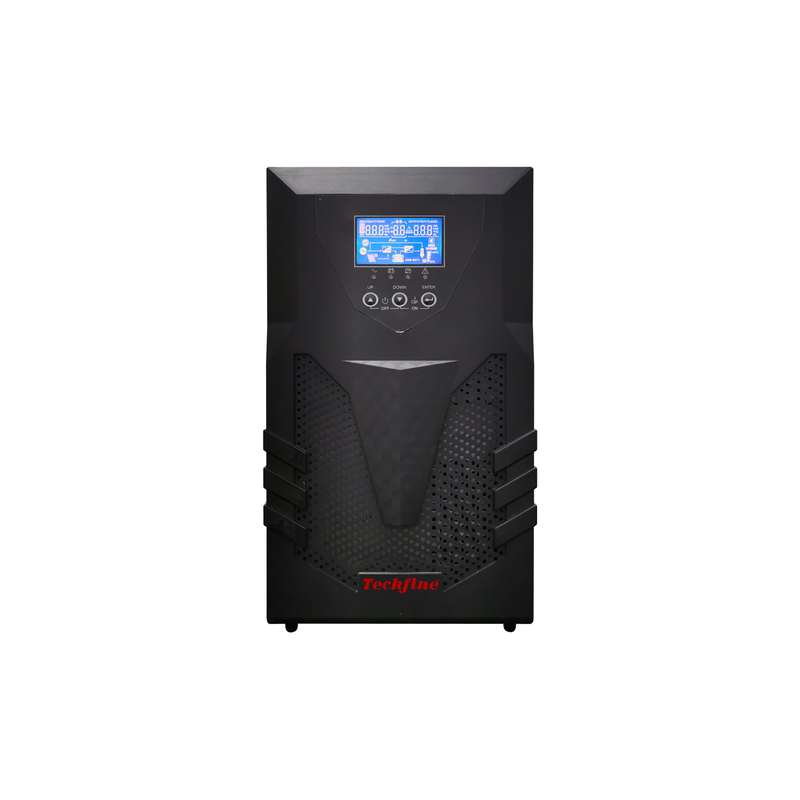
The CQ series and CYF series provide product starting points. Send the load schedule, desired duration and recovery pattern with the enquiry. Confirm which battery configuration is included in the quotation and request the corresponding runtime basis.
Frequently asked questions
Will a 2000 VA UPS run twice as long as a 1000 VA model?
Not necessarily. VA is a power-capacity rating; runtime requires the battery and load information for each model.
Can I estimate from amp-hours alone?
No. Voltage, discharge conditions, usable energy and conversion behavior are also relevant.
Does a displayed remaining-time value replace a runtime requirement?
No. Understand the estimate’s basis and maintain the battery and configuration according to the approved plan.