A UPS has both a watt rating and a volt-ampere rating because connected equipment can impose two different power constraints. A load must fit both. Selecting only by the larger VA number can leave the UPS overloaded in watts, while selecting only by watts can overlook apparent-power demand. Build a load schedule using the actual quantities before comparing models.
Distinguish real and apparent power
Watts describe real power. Volt-amperes describe apparent power, related to RMS voltage and current in the relevant AC arrangement. For a load, power factor is the ratio of real power to apparent power. Where suitable values are known, apparent power can be calculated as watts divided by power factor.
Do not assume one fixed power factor for all computers or appliances. Equipment design and operating condition affect the value. Use reliable load information or appropriate measurements. Schneider Electric’s UPS selection guide distinguishes watt and VA ratings; the final comparison needs the exact UPS and load data.
Work through a simple example
Suppose an illustrative device consumes 450 W at a power factor of 0.90. Dividing 450 by 0.90 gives 500 VA. The selected UPS must accommodate at least both quantities under the applicable operating conditions, with appropriate design allowance and transient assessment. The example is arithmetic, not a recommendation for a particular model or service margin.
A hypothetical UPS rated 600 VA and 360 W would fail the watt requirement despite its VA rating exceeding 500 VA. Another rated 400 VA and 400 W would fail both requirements. A larger-looking catalogue number does not rescue a mismatch in the other constraint.
| Illustrative UPS rating | 450 W load check | 500 VA load check | Initial result |
|---|---|---|---|
| 600 VA / 360 W | Exceeds watt rating | Within VA rating | Unsuitable on watts |
| 400 VA / 400 W | Exceeds watt rating | Exceeds VA rating | Unsuitable on both |
| 1000 VA / 800 W | Within watt rating | Within VA rating | Continue other compatibility checks |
Passing these two initial checks is not the complete selection. Startup behavior, output waveform, voltage, runtime and the supported installation still matter. The table isolates the rating comparison so it is clear why both columns must be considered.
Do not confuse the UPS output ratio with load power factor
A UPS’s listed watt capacity divided by its VA capacity describes the relationship between those two published output limits. That ratio is not automatically the power factor of the connected equipment. A load’s power factor must come from its own behavior or data, not from the model the buyer hopes to use.
Input power factor is another separate specification associated with how equipment draws power upstream. Keep input and output quantities labelled in the worksheet. Similar terminology can otherwise lead a buyer to use an attractive specification from the wrong part of the system.
Measure the intended operating load
List all devices connected to battery-backed outlets or distribution. Record their expected simultaneous operating demand, not just a collection of maximum adapter labels or an idle reading from one device. For computing equipment, consider the workload that represents demanding normal use.
Appropriate measurements can improve the estimate, but the instrument must report the relevant quantities and conditions. A basic energy total over a day does not establish peak VA demand. Ask a qualified person to interpret measurements where the application is complex or the consequences of interruption are significant.
Include shared equipment and future additions
A workstation setup can include monitors, network equipment and external storage. A rack can acquire new devices between the original quotation and installation. Keep the load schedule current and identify which outlets are intended to receive backup. Surge-only outlets, where provided, perform a different role from battery-backed outlets.
State any planned expansion explicitly. A reasonable growth allowance should follow a defined requirement rather than an unexplained percentage copied from another project. Check that the proposed UPS still meets runtime and physical requirements when the future load is included.
Review short-duration and unusual loads separately
Some devices have startup or inrush behavior that a steady watt and VA calculation does not fully describe. Equipment with motors, transformers or demanding electronic inputs needs the relevant compatibility review. The UPS’s continuous ratings are not a complete overload-time specification.
Do not assume that a UPS intended for IT loads is suitable for every appliance within its nominal watt limit. Send the exact equipment information to the supplier. A model-specific answer is more useful than applying one generic starting multiplier to a mixed load.
Keep battery duration out of the rating shortcut
A higher VA rating does not by itself guarantee a particular runtime. Two models can have different battery configurations, efficiencies and permitted loads. After establishing adequate power capacity, use the manufacturer’s runtime information for the exact battery arrangement and actual load.
Also check the runtime objective: enough time to shut down, bridge an interruption or maintain service for a defined period. A UPS can be correctly sized in watts and VA yet still have insufficient battery duration for that objective. These are complementary checks, not alternative ways to size the same thing.
Read Techfine model columns as paired ratings
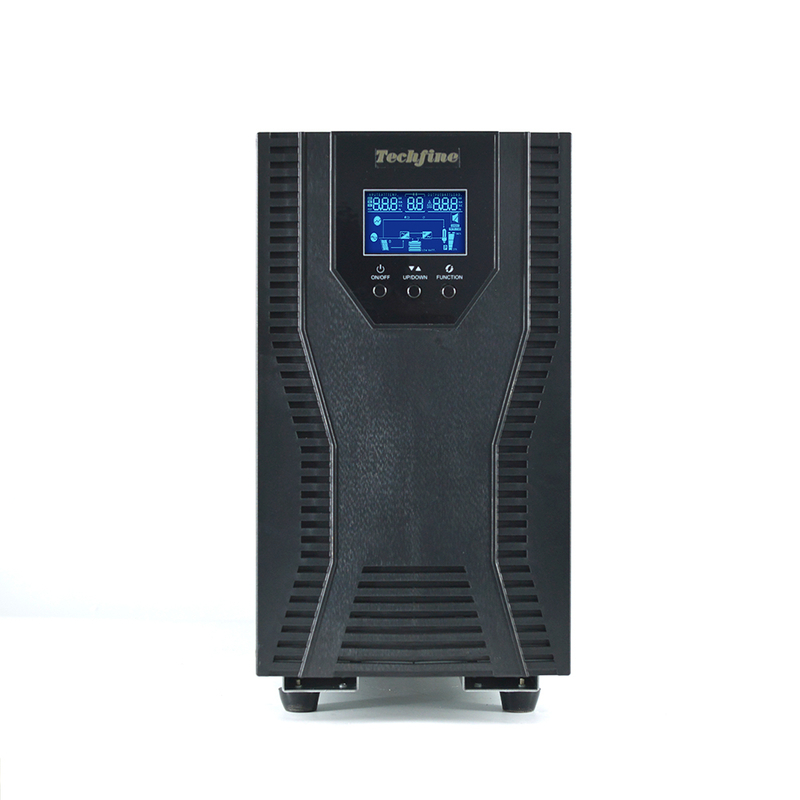
The Techfine CQ series and CYF series provide model-specific VA and watt capacities. Keep the pair from the same column. A series can contain variants with different output-capacity relationships, so do not select VA from one version and watts from another.
Send a worksheet listing each device, watts, VA or known power factor, expected simultaneous duty and any startup concern. Ask the supplier to confirm the proposed model against both totals and the other application requirements. Preserve the accepted load schedule for future additions.
Avoid averaging power factors casually
For a mixed load, keep each device entry traceable to its data or measurement. Do not take a simple average of several power-factor labels and apply it to an unrelated total watt figure. The aggregate electrical behavior depends on the actual equipment and simultaneous operating condition.
If the worksheet combines estimates and measurements, label them distinctly and ask the designer how the total is assessed. That is especially useful when a proposal is close to a capacity limit. Better evidence can resolve uncertainty more effectively than assuming every load always operates at its nameplate maximum or its lowest observed idle demand.
Frequently asked questions
Can I treat 1000 VA as 1000 W?
Only a model explicitly rated for that watt output has that particular capacity relationship. Always read both published ratings.
Can watts be multiplied by power factor to obtain VA?
For the stated relationship, VA equals watts divided by power factor. Check that the power factor and power values describe the same load condition.
Does passing both power ratings finish UPS selection?
No. Confirm voltage, waveform, transient behavior, runtime, connections and management requirements for the complete application.