An inverter can offer both AC charging and solar charging, yet the two headline current ratings do not automatically add up to a safe battery setting. The battery has its own limits, the inverter can have a combined limit, and other chargers may also contribute. Build a complete charging budget before commissioning so every source respects the selected battery’s permitted operation.
Identify the point at which current is specified
A PV input current, an AC input current and a battery charging current refer to different parts of the system. They may be measured at very different voltages and cannot simply be added together. When comparing a specification, preserve the units and the location of each value. Ask the supplier to clarify a table that labels several different quantities only as current.
For the charging budget, identify the limits that apply on the battery side and how the inverter controls them. Also distinguish a hardware maximum from a configured operating limit. A menu value that permits a large current is not a recommendation to use it with every compatible nominal-voltage battery.
Start with the battery manufacturer’s limits
Record the battery model, module count, chemistry and approved charging conditions. Find its continuous charging limit and any restrictions related to temperature, state of charge or other conditions. A managed battery may communicate a changing limit. The complete system must respect the applicable limit rather than assuming one fixed catalogue value is always available.
Capacity in amp-hours is not enough to choose a charging current without the battery documentation. Nor does a larger inverter authorize faster charging. If several battery modules are used, obtain the supplier’s approved bank configuration and aggregate charging capability. Do not assume that adding module counts automatically multiplies every limit in all operating conditions.
List every possible charging source
Include the built-in AC charger, built-in solar controller and any external charger that can operate at the same time. Identify which components share a common control system and which act independently. An overlooked external charger can invalidate a calculation that looked correct when only the inverter’s settings were considered.
Describe when each source is permitted to operate. Utility availability, solar conditions, time schedules and system permissions can change the combination. Use the highest credible simultaneous charging case for review, while also checking the battery’s more restrictive operating conditions. A system should not rely on the weather to prevent an excessive combined request.
Use an illustrative current budget
Assume a hypothetical battery permits 60 A charging under the reviewed conditions. Suppose the proposed solar charging allocation is 40 A and the AC charging allocation is 30 A. Their potential sum is 70 A, so the proposal needs an approved control arrangement that keeps the battery within its 60 A limit, or revised source limits. These values are examples, not settings for a Techfine model.
| Illustrative item | Current | Question to resolve |
|---|---|---|
| Battery permitted charge current | 60 A | Under which conditions is this available? |
| Proposed solar allocation | 40 A | Is it a source limit or part of a coordinated total? |
| Proposed AC allocation | 30 A | Can it overlap with solar charging? |
| Potential uncoordinated sum | 70 A | How will the approved system constrain the total? |
The correct settings depend on how the equipment interprets its source and total limits. One product may coordinate sources internally; another arrangement may need system-level management. Do not copy the smaller number into an arbitrary menu and assume that the whole installation now follows the intended budget.
Read combined-limit behavior in the manual
A specification can list separate maximum solar and AC charging currents alongside a maximum total charging current. The total may be lower than their arithmetic sum. Check the exact model column, mode descriptions and configuration instructions. Confirm which source takes priority when the total limit is reached and whether that behavior is adjustable.
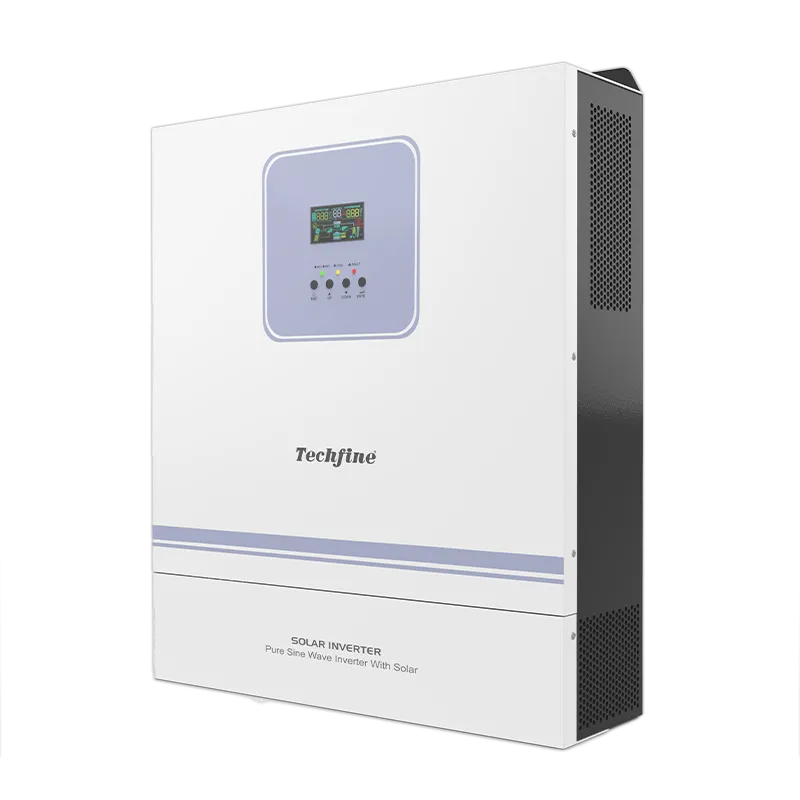
The Techfine GA Pro Plus specification shows separate charging-related fields across model variants. Use the applicable model documentation to interpret them together. Do not select the largest value from each column and assemble an imaginary configuration that no actual model provides.
Account for managed limits and control scope
Where a battery communicates permitted charging limits, confirm which chargers receive or obey that information. An integrated charger and an independent external controller may not share the same control scope. Ask the designer to identify how the complete arrangement remains within the battery’s requirements if one source operates independently.
Victron’s DVCC documentation is an example of manufacturer-specific coordinated voltage and current control with defined capabilities and limits. Its rules apply to its supported system. A Techfine proposal requires its own documented control arrangement rather than an assumption that another manufacturer’s behavior is universal.
Do not confuse net battery current with charger output
Loads can consume some of the power being supplied while a battery is charging. A dashboard may show net battery current, source output or another calculated value. Understand the display definitions before using a low reading as proof that source limits are correct. A later reduction in load can change the battery’s net charging demand.
For acceptance, record the relevant source outputs, battery information and active limits together under the approved test conditions. A single screenshot taken while the site is consuming substantial power does not demonstrate that the combined charging controls will remain correct when that consumption stops.
Plan commissioning and ownership of settings
Qualified personnel should configure charging according to the battery and inverter documentation, then record the approved values and control modes. Identify who may change them later. Faster charging should not be offered as a casual user adjustment without considering battery limits and the rest of the system.
Keep a record of firmware, source limits, combined limits, battery configuration and any external chargers. Revisit the budget when adding PV capacity, replacing a battery, enabling utility charging or changing a charger. A new source can alter the simultaneous case even if the original inverter settings remain untouched.
Prepare a complete Techfine enquiry
Start with the GA Pro Plus product page and identify the exact intended model. Provide the battery datasheet, module arrangement, all charging sources and desired operating policy. Ask the supplier to explain the source-priority and total-current behavior for that configuration.
The most useful response is a reviewed charging budget and configuration basis, not simply confirmation of the inverter’s maximum charging current. Keep the supplier’s answer with the commissioning record so future service work can preserve the original design intent.
Frequently asked questions
Can I add the solar and AC charging ratings?
Not without checking the combined limit and control behavior. The battery’s permitted charging conditions remain an independent constraint.
Does the BMS make every charger setting irrelevant?
No. Equipment settings and supported control integration still matter. Protective intervention is not a substitute for an approved charging configuration.
Can I choose charge current from battery amp-hours alone?
No. Use the battery manufacturer’s specified limits and conditions for the actual bank, together with the system design.