Automatic Voltage Regulation and battery backup address different supply conditions in a UPS. AVR can correct specified utility-voltage variations without changing to battery operation, while the battery supports the load when the normal source is no longer acceptable under the product’s rules. Understanding that distinction helps explain what the UPS is doing during a brownout and why a voltage-regulation feature is not a substitute for stored energy.
Separate a low-voltage condition from a complete outage
A supply can remain present while its voltage falls outside the preferred range for connected equipment. That differs from having no usable source at all. Record the nature of the site’s problem rather than describing every event as a blackout. The frequency, duration and severity of the condition influence the selection discussion.
A UPS’s response depends on its architecture, accepted input window, regulation capability and settings. A line-interactive unit may regulate a condition within its supported range, then transfer to battery when another condition is met. Confirm the model’s actual behavior instead of assuming that all low-voltage events produce the same response.
Understand what AVR contributes
AVR adjusts specified input-voltage variations to support the output within the product’s stated behavior. Eaton’s OMNI AVR explanation describes correction of minor power fluctuations without switching to battery. That is a functional example, not a specification for every UPS.
Read the exact regulation and input information for the selected Techfine model. Do not assume AVR corrects every disturbance, provides unlimited voltage adjustment or guarantees a perfectly constant output. Frequency, waveform and other power-quality questions need their own specification checks.
Understand when stored energy matters
When the normal source is unavailable or outside the supported conditions, a suitable UPS can use its battery and inverter to supply the load. This requires a serviceable battery, adequate output capacity and sufficient energy for the intended duration. AVR alone cannot create energy during a complete loss of supply.
A standalone voltage regulator and a UPS therefore answer different needs. A site requiring time for a controlled shutdown must assess battery duration as well as voltage correction. Conversely, buying a UPS does not remove the need to understand whether the site’s input conditions are within the supported operating arrangement.
Read the input window with its conditions
A stated input range may depend on load, mode or other conditions. Preserve those qualifications when comparing products. A wide range at partial load should not be treated as the full-load specification unless the documentation says so. Also distinguish an accepted input range from the specific range in which AVR provides its intended regulation.
Ask the supplier how switching thresholds and recovery behavior apply to the exact voltage version. If an adjustable setting is provided, its selection should follow the load requirements and approved application. Widening a window without reviewing the equipment is not automatically an improvement.
Interpret frequent battery events
A series of short transfers can indicate recurring source conditions rather than a simple lack of battery capacity. Record event times, reported input conditions, operating mode and connected load. If the battery has little recovery time between events, available energy for a later interruption can differ from the fully charged case.
Do not replace the battery or change thresholds solely from the number of audible clicks or alerts. Determine what each indication means in the actual manual. A qualified review can distinguish normal regulation behavior, transfers, an unsuitable input environment and a fault requiring service.
Use an operating-state comparison
| Observed condition | Function to review | Question for the supplier |
|---|---|---|
| Moderate utility-voltage variation | Supported AVR behavior | Can this model regulate the condition at the intended load? |
| Input outside supported conditions | Transfer to battery and accepted limits | What thresholds and mode apply? |
| Complete outage | Battery-supported output | Can the battery and UPS support the required service? |
| Utility recovery | Return and recharge behavior | How is output maintained and battery energy restored? |
The table separates control functions from energy requirements. It also helps a customer describe a problem precisely: a low-voltage event while the UPS remains on line is different from a battery shutdown after a prolonged outage.
Check connected-equipment compatibility
The load must tolerate the output in both normal and battery modes. Verify voltage, frequency, waveform and transfer behavior for the intended equipment. An AVR feature statement does not establish compatibility with every power supply or process controller.
Identify the consequence of a brief interruption. Where a service must remain uninterrupted, include the complete equipment chain in the acceptance plan. Do not infer success for all loads from one device remaining on during a demonstration.
Assess the underlying supply problem
Persistent abnormal input conditions may require attention to the site’s upstream electrical supply. A UPS is part of the power arrangement, not a reason to ignore repeated alarms or abnormal conditions. Qualified personnel should investigate the source where appropriate.
Provide useful records rather than making unsupported adjustments. Event history, actual mode and equipment identity give the installer a basis for the next action. Avoid disabling protection or forcing operation outside documented conditions to reduce the number of battery events.
Compare Techfine regulation and backup separately
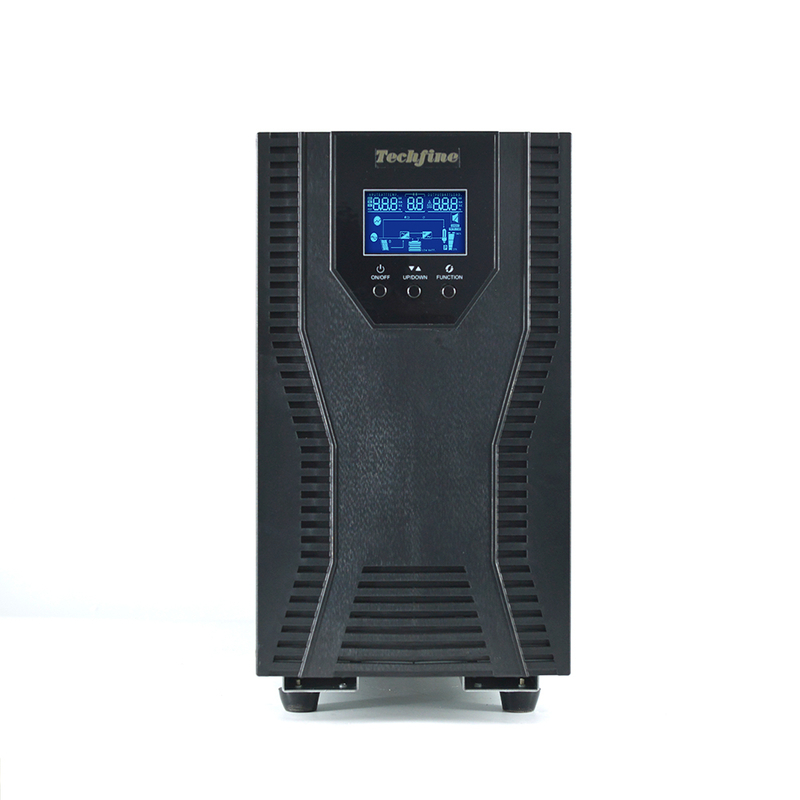
The Techfine CYF description identifies AVR as part of its line-interactive platform. Confirm the applicable input and output specifications for the chosen model and operating load. Use the CYF product page to anchor the quotation.
Send the load schedule, observed supply conditions and runtime objective together. Ask for the proposed regulation behavior, transfer conditions and battery arrangement. A complete response should show how the system addresses both voltage variation and actual loss of power.
Keep the handover practical
Explain the normal indications for regulation, battery operation and alarms using the supplied manual. Identify who reviews repeated events and who maintains the battery. Keep the approved settings with the system record so later service does not unknowingly change the accepted behavior.
Frequently asked questions
Does AVR provide backup during an outage?
No. Backup energy comes from the supported storage and conversion arrangement, not voltage regulation alone.
Does an AVR indication always mean a fault?
No. It may indicate normal regulation. Interpret it using the exact model’s manual and the actual conditions.
Should I widen the input window to avoid battery use?
Only use an approved configuration appropriate to the connected equipment and site. Investigate repeated abnormal conditions first.