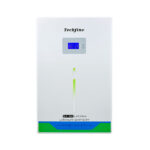
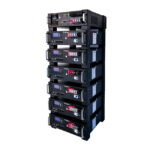
At the same 51.2 V nominal voltage, choosing 100 Ah, 200 Ah or 300 Ah changes the battery’s nominal energy. It does not automatically change every power, communication or installation limit in the same proportion. Compare the three capacity options around the required service duration, permitted output and practical installation rather than assuming the largest Ah version is the best system choice.
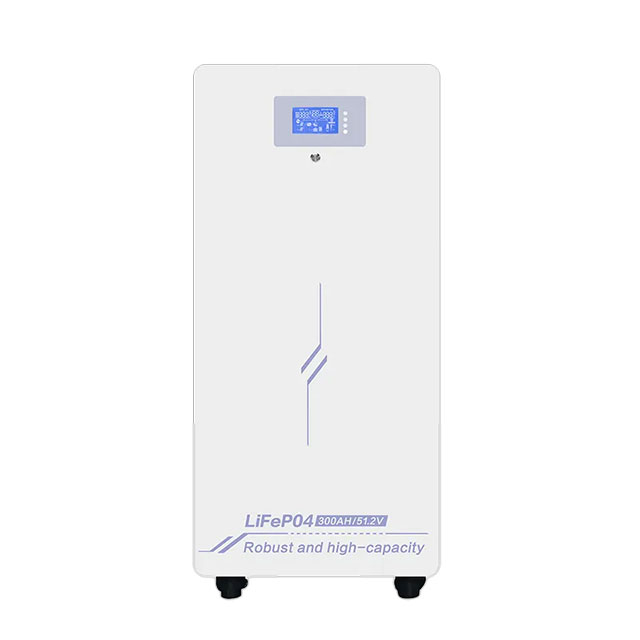
Put the three options on one energy basis
Multiplying 51.2 V by 100 Ah gives 5.12 kWh of nominal energy. The same calculation gives 10.24 kWh for 200 Ah and 15.36 kWh for 300 Ah. These values are nominal arithmetic at the stated voltage, not guaranteed usable AC energy or verified runtime under an arbitrary load.
| Illustrative nominal capacity | Energy at 51.2 V | Separate information still required |
|---|---|---|
| 100 Ah | 5.12 kWh | Usable window, discharge power and charge limits |
| 200 Ah | 10.24 kWh | Exact BMS, installation and compatibility data |
| 300 Ah | 15.36 kWh | Permitted duty, physical arrangement and recovery conditions |
Keep the same energy definition across quotations. A defined usable figure from one model should not be compared with a nominal figure from another as though they represent the same delivered service.
Start with the duration the customer actually needs
Define the services to preserve and the time they must run. A customer trying to bridge a short interruption has a different requirement from one planning an extended overnight reserve. Record which loads can be postponed and which must remain available throughout the specified interval.
For an illustrative demand of 1.2 kW over four hours, the load energy is 4.8 kWh before system losses and reserve are considered. That makes a useful requirement to review, but it does not establish that a nominal 5.12 kWh pack meets the complete objective. The usable operating window and system consumption must also fit.
Check permitted power for each version
A larger Ah rating does not prove a proportionally larger BMS current limit. Different pack versions can use different management hardware and permitted duty. Request continuous and short-duration discharge information for each exact model, along with the applicable temperature and battery-state conditions.
If two hypothetical versions shared the same permitted output limit, the larger energy version could offer longer service at an accepted load without offering a higher permitted peak load. This is a conceptual example, not a statement that particular Techfine packs share a current limit. Read the model specifications rather than assuming how the versions are configured.
Keep inverter compatibility model-specific
All three options being described as 51.2 V does not establish compatibility with every inverter advertised for a 48 V platform. Check the permitted battery operating range, management integration and approved configuration. Capacity selection follows that compatibility review rather than replacing it.
Ask the suppliers to confirm the exact battery and inverter combination. Include required communication accessories and the supported protocol where applicable. A larger pack should not be substituted late in procurement without reviewing whether the approved integration remains the same.
Review charging and recovery
More stored energy can require more time to restore when charging power is constrained. A site with a limited solar charging opportunity or restricted AC charging policy may not replenish a larger battery as expected after a demanding outage. Compare the energy to be restored with the actual available charging arrangement.
An ideal energy-divided-by-power calculation can explain the scale, but it does not include charging stages, limits or varying solar production. Ask for the relevant charge-current requirements and recovery basis for the proposed version. The ability to store more energy is useful only within a realistic operating plan.
Assess physical installation and maintenance
Compare dimensions, mass, mounting arrangement and required access for the exact versions. A location suitable for a smaller pack may need a different support or service approach for a larger one. Keep those requirements in the layout before selecting by capacity alone.
Determine how the pack is installed and serviced by qualified personnel. Do not infer that a larger capacity fits the same bracket or can be handled in the same way because the front panels look similar. The quotation should include the correct mounting or cabinet equipment for the actual product.
Compare one larger pack with an approved modular arrangement
A requirement might be met by one larger pack or by a supported group of smaller modules. That comparison needs manufacturer approval for the proposed arrangement, not only an equal total kWh. Module coordination, protection, communications and installation can differ.
Ask how faults, service and later expansion are handled in each proposal. Do not assume that several modules automatically provide redundancy or that one larger pack is always simpler to maintain. Compare the complete supported architecture and its responsibilities.
Use the same load profile in every quotation
Give each supplier the same running demand, duration, startup concerns, reserve policy and recovery expectation. Otherwise, a larger battery may appear to provide a better result simply because its quotation assumes a lighter load or a deeper operating window.
Separate confirmed facts from estimates. If the load profile is not measured, identify the basis and the uncertainty. An explicit assumption is easier to improve than an apparently precise runtime obtained from an unexplained capacity multiplier.
Make the decision worksheet service-focused
| Decision area | Question across all three options |
|---|---|
| Energy requirement | Does defined usable energy cover the agreed duration and reserve? |
| Power requirement | Can the exact version support the accepted demand? |
| Recovery | Can the available charging arrangement restore the required energy? |
| Installation | Does the site support the mass, dimensions and service access? |
| Integration | Is the battery/inverter combination explicitly supported? |
The worksheet should lead to the smallest complete solution that meets the actual requirement with the approved design basis, rather than a capacity choice made in isolation. Keep the accepted assumptions with the purchase record.
Discuss Techfine capacity options precisely
The Techfine LC series presents capacity variants. Use the exact model and current datasheet when comparing them. The LC product page can identify the family in the enquiry, while the supplier confirms the selected configuration and applicable limits.
Frequently asked questions
Does 300 Ah mean three times the output power of 100 Ah?
No. Nominal energy scales with Ah at the same voltage, but permitted power must be checked for each model.
Will a larger pack always improve outage performance?
It may add energy, but the load, inverter, battery power limits and recovery plan still constrain the service.
Can I choose by kWh and ignore physical size?
No. Mounting, weight, clearances and maintenance access remain part of the selection.